The hidden language of rhythm: Why tap dancers are secret mathematicians
When you stand outside our studio doors in North West, you aren’t just hearing the rhythmic echo of shoes on timber; you are listening to the sound of applied mathematics. While most people see tap dance as a purely theatrical art form, it is actually a high-speed exercise in numerical logic, patterns, and physics. At Dance 24 Seven, we’ve watched our dancers grow not just in grace, but in their ability to solve complex problems, and the science behind why this happens is fascinating.
The connection begins with the way a dancer perceives time. In a typical maths classroom, a student might see a fraction written on a whiteboard, but in a tap class, they become the fraction. To hit a syncopated beat, a dancer must subconsciously divide a bar of music into halves, quarters, and sixteenths, executing those divisions with millisecond precision. This physical embodiment of fractions creates a deep-seated understanding of how numbers work in the real world, turning an abstract concept into a tangible, felt experience.
This numerical fluency extends into the world of algebra through the mastery of patterns and sequencing. Every time step or shuffle-ball-change is a formula. Our students learn to recognise these patterns and then interchange or reverse them, much like solving an equation. Because our classes with the ADPA Tap syllabus requires such a high level of technical accuracy, students develop an auditory feedback loop. They can hear immediately if a calculation is off-beat, fostering a mindset of precision that is essential for success in STEM subjects.
Beyond the numbers, there is the geometry of the body. Tap dancing requires a sophisticated understanding of angles and force. To create the crisp, clear sounds that earned our students top marks in the world during the 2025 exam season, a dancer must manage their centre of gravity and the trajectory of their feet with the precision of a physicist. This multitasking, balancing the body while simultaneously "drumming" a complex rhythm, strengthens the brain's executive function, allowing students to handle multi-step tasks with much greater ease.
Ultimately, we see tap dance as the ultimate workout for a developing brain. By the time our dancers reach their mid-year exams, they aren't just performers; they are thinkers who can navigate complex patterns and logical sequences with confidence. At Dance 24 Seven, we take pride in knowing that the discipline learned on our purpose-built wooden floors is giving our students a rhythmic head start in the classroom and beyond.
Experience the logic of the beat for yourself. Enrolments for our 2026 Tap classes are now open in Auckland
The Source: Studies such as those by Dr. Linda Christensen and research published in the Journal of Dance Education explore "Embodied Learning." This research shows that when students use their bodies to represent spatial or numerical concepts (like the subdivisions of a beat in Tap), they retain the information better than through rote memorisation.

Frequently Asked Questions (FAQ)
How does tap dance help children with math? Tap dance is "embodied mathematics." Dancers constantly use fractions to subdivide beats into halves, quarters, and sixteenths. By physically performing these numerical divisions, students develop a tangible understanding of fractions and rhythm that often translates to better performance in the classroom.
What is the best age for a child to start tap dance? We offer tap classes for children as young as five at our Whenuapai studio. Starting young helps develop early coordination and auditory processing. However, because it is so logic-based, many older children and even adults in the North West find it a rewarding "brain workout" to start later in life.
Is tap dance more difficult than other dance styles? Tap requires a unique type of coordination because you are a dancer and a percussionist simultaneously. While it can be challenging to master the "music theory" of your feet, the ADPA Tap syllabus we follow provides a structured, step-by-step roadmap that makes learning the logic of the beat fun and accessible.
Will tap dance help my child’s focus and memory? Yes. Learning tap routines involves memorising complex sequences and patterns, which is essentially an exercise in algebraic thinking. Research into "Embodied Learning" shows that moving the body while learning patterns helps the brain retain information more effectively than traditional rote memorisation.
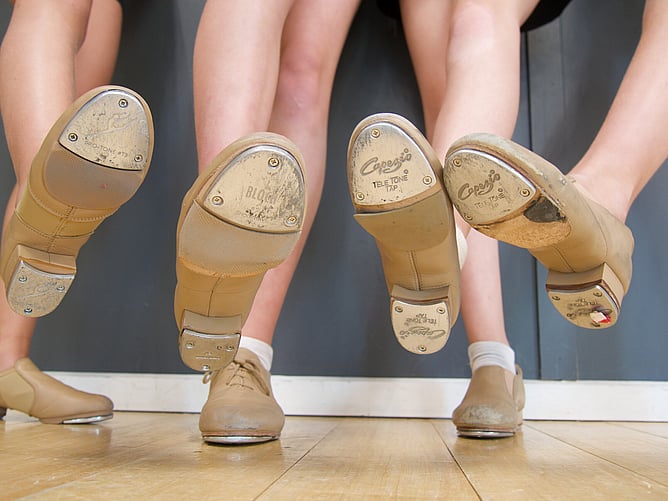
What gear is needed for a tap dance class in Auckland? To get those crisp, "mathematic" sounds, you need quality tap shoes with secure plates. For your first Free Trial at our Whenuapai facility, a hard-soled school shoe is a fine temporary substitute. We can advise on the best local suppliers to ensure your child has the right "instruments" for their feet once they enrol.
Are tap dance results part of your "Top in the World" rankings? Absolutely. Our tap dancers contributed significantly to our record-breaking 2025 exam results. The precision required for high-level tap dance is exactly why our students achieve such high technical marks in international examinations.